
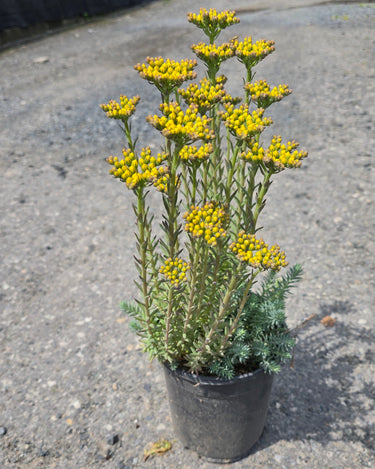

Blue Moon Stonecrop
Silvery blue-grey needle-like succulent foliage forms a spreading low mat with yellow star-shaped flowers in summer — a striking and drought-tolerant groundcover sedum for sunny borders and rock gardens. (Sedum reflexum Blue Moon)
Sedum reflexum Blue Moon™ (Nonesordr) is a cool-toned, mat-forming perennial succulent prized for its silvery blue-gray foliage and tidy, upright needle-like leaves. It spreads quickly and forms a durable, water-wise groundcover in sunny, well-drained sites. Though it produces small yellow flowers in early summer, the foliage is the main attraction—providing a calm, modern aesthetic and year-round presence in the landscape.
Perfect for edging, green roofs, dry slopes, rock gardens, or containers, Blue Moon™ adds visual structure and a cooling tone even in heat and drought. Its evergreen foliage and no-fuss nature make it a reliable, attractive choice for xeric and contemporary gardens.
Your payment information is processed securely. We do not store credit card details nor have access to your credit card information.
Growing Information
Growing zone guideLearn more about this plant
Additional Information
| Growth Rate | |
|---|---|
| Colorful Leaves | Yes |
| Flowering | |
| Bloom Color | Yellow |
| Ornamental Berries | N/A |
| Disease resistant | |
| Cold Tolerant | |
| Heat Tolerant | |
| Drought Tolerant | |
| Deer Resistant | |
| Edible | |
| Wildlife Attraction | |
| Self-pollinating | Self-pollinating |
| Seasonality | |
| Ideal For | |
| Leaf Description | |
| Flower Description | |
| Pruning & Maintenance | |
| Water Needs | |
| Light Needs | |
| Harvesting | |
| Fertilizing | |
| Additional Care Tips | N/A |
| Pollination | |
| Companion Plants |
Flowering and Seasonality
Pet Friendly
Yes
Growing Zone
- Zone 4
- Zone 5
- Zone 6
- Zone 7
- Zone 8
- Zone 9
Click to enlarge
Growing Zone

You may also like


