Growing Information

Growing zone guide
Growing Zone Zone 2, Zone 3, Zone 4, Zone 5, Zone 6, Zone 7
Sunlight Bright light to partial shade
Type of Soil Acidic to neutral
Mature Height 6 to 12 inches.
Maintenance Level Low maintenance
Water Requirement Moderate watering (once a week)

Learn more about this plant

Additional Information
Growth Rate
  • Growth Rate: Slow-growing but forms a dense, spreading mat over time.
  • Mature Size: Reaches a height of 6-12 inches with a spread of 3-6 feet, making it an excellent groundcover for erosion control and covering large areas.
Colorful Leaves Yes
Flowering Yes
Bloom Color Pink
Ornamental Berries Red berries
Disease resistant Yes
Cold Tolerant Yes
Heat Tolerant Yes
Drought Tolerant Yes
Deer Resistant Yes
Edible No
Wildlife Attraction

Bearberry attracts a variety of wildlife. The flowers provide nectar for bees and other pollinators, while the berries are a favorite food for birds, such as grouse and songbirds, and small mammals. The dense foliage also offers shelter for small wildlife.

Self-pollinating Self-pollinating
Seasonality
  • Seasonality: Evergreen, retaining its leaves throughout the year.
  • Flowering Season: Late spring to early summer (April-June)

Fall/Winter Color: The foliage may take on a reddish-purple hue in colder months, adding seasonal interest.

Ideal For
  • Groundcover for slopes, erosion control, and rocky or sandy soils
  • Excellent in naturalistic plantings, woodland gardens, or native plant landscapes
  • Understory planting beneath trees or shrubs
  • Ideal for xeriscaping and low-maintenance gardens
  • Performs well in coastal and alpine settings

Leaf Description
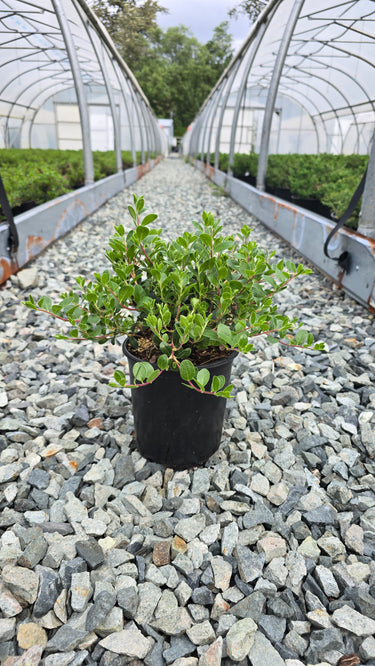
  • Foliage: The leaves are small, thick, and leathery, with a dark green color that remains year-round. Each leaf is oval-shaped with a glossy texture, forming a dense mat of foliage. In colder weather, the leaves may turn a reddish-bronze, providing additional seasonal interest.
Flower Description
  • Flowers: Arctostaphylos uva-ursi produces small, urn-shaped, pinkish-white flowers in clusters. These delicate blooms appear in late spring and early summer, adding a soft touch of color to the plant. The flowers are followed by bright red berries in late summer to fall.
Pruning & Maintenance

Pruning is not usually necessary, but light pruning can be done in late winter or early spring to remove any dead or damaged branches. Prune to shape the plant or control its spread if needed.

Water Needs

Once established, Arctostaphylos uva-ursi is highly drought-tolerant and requires minimal watering. During the first growing season, water regularly to help the plant establish deep roots. After that, only water during prolonged dry periods.

Light Needs

Thrives in full sun to partial shade. For best results, plant in an area that receives at least 6 hours of direct sunlight per day. It can tolerate some shade but will grow more slowly in lower light conditions.

Harvesting

The berries of Bearberry are edible and have been traditionally used in herbal medicine. However, they are quite tart and are typically used in jams or jellies. If harvesting for consumption, collect the berries in late summer or early fall when they are fully ripe.

Fertilizing

Arctostaphylos uva-ursi does not require fertilization, as it thrives in poor, nutrient-deficient soils. However, you can apply a light layer of compost in spring to encourage healthy growth if desired. Avoid using chemical fertilizers, as they may harm the plant's natural ability to thrive in tough conditions.

Additional Care Tips
  • Mulching: Apply a light layer of mulch around the base of the plant to retain moisture, control weeds, and regulate soil temperature.
  • Pest and Disease Resistance: Bearberry is highly resistant to pests and diseases, making it a low-maintenance choice for groundcover.
  • Winter Care: No special winter care is needed. Bearberry is highly cold-hardy and can withstand harsh winter conditions without losing its foliage.
Pollination
  • Pollination Type: Self-fertile, but insect activity improves fruit set
  • Flowers: Small, urn-shaped, white to pink blossoms bloom in spring (April–May)
  • Pollinators Attracted:
  • Native bees, honeybees, and some butterflies
  • Fruit: Red berries appear in late summer to fall; eaten by birds and wildlife
  • Wind does not play a major role; bee pollination is primary

Companion Plants

Pair Bearberry with other native or low-water-use plants that thrive in acidic, well-drained soils:

🌲 Evergreens & Shrubs

  • Vaccinium vitis-idaea (Lingonberry) – Edible red berries and similar growth habit
  • Gaultheria procumbens (Wintergreen) – Low-growing with aromatic leaves and red berries
  • Rhododendron or Azalea – For varied height and spring flowers
  • Kalmia latifolia (Mountain Laurel) – Acid-loving and shade tolerant

🌾 Grasses & Perennials

  • Carex pensylvanica – Native sedge for soft texture
  • Eriogonum umbellatum (Sulphur Buckwheat) – Great for dry, rocky areas
  • Heuchera americana – Adds foliage contrast in partial shade

  • Lupinus perennis – Wild lupine that adds nitrogen and blooms
Flowering and Seasonality
  • Seasonality: Evergreen, retaining its leaves throughout the year.
  • Flowering Season: Late spring to early summer (April-June)

Fall/Winter Color: The foliage may take on a reddish-purple hue in colder months, adding seasonal interest.

  • Flowers: Arctostaphylos uva-ursi produces small, urn-shaped, pinkish-white flowers in clusters. These delicate blooms appear in late spring and early summer, adding a soft touch of color to the plant. The flowers are followed by bright red berries in late summer to fall.
Pet Friendly

Yes

Growing Zone
  • Zone 2
  • Zone 3
  • Zone 4
  • Zone 5
  • Zone 6
  • Zone 7

Click to enlarge