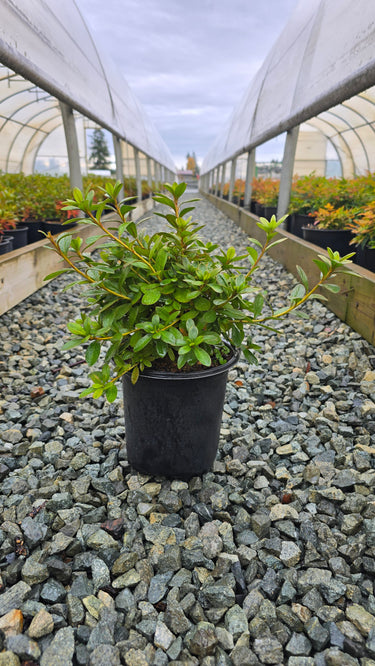
Growing Information

Growing zone guide
Growing Zone Zone 5, Zone 6, Zone 7, Zone 8
Sunlight Partial shade
Type of Soil Acidic
Mature Height 2 to 3 ft.
Maintenance Level Moderate maintenance
Water Requirement High water needs (twice a week)

Learn more about this plant

Additional Information
Growth Rate

Moderate growth rate.


Matures to about 2–3 feet tall and 3–4 feet wide, forming a rounded, dense, evergreen mound.


Well-suited for smaller gardens and foundation plantings due to its compact habit.

Colorful Leaves Yes
Flowering Yes
Bloom Color Purple & Lavender
Ornamental Berries N/A
Disease resistant Yes
Cold Tolerant Yes
Heat Tolerant No
Drought Tolerant No
Deer Resistant Yes
Edible No
Wildlife Attraction

Flowers attract bees, butterflies, and hummingbirds during bloom season.


Provides shelter for small birds and beneficial insects.


Foliage is mildly toxic, so it’s generally avoided by deer and rabbits.

Self-pollinating Self-pollinating
Seasonality

Evergreen year-round in most regions, with the heaviest display of color in May.


Spring: Peak bloom of vivid purple flowers.


Summer: Glossy green foliage provides structure.


Fall/Winter: Leaves develop bronzy or purplish tones for winter interest.

Ideal For

Woodland gardens, shaded borders, foundation plantings, naturalized settings, acid-soil landscapes, mixed shrub borders

Leaf Description
  • Evergreen to semi-evergreen, depending on winter severity.

  • Leaves are elliptical, leathery, and glossy dark green, about 1–2 inches long.

  • In colder climates, foliage may take on a purplish-bronze hue in winter for added seasonal color.
Flower Description

Produces large, vibrant purple-lavender blooms in mid to late spring.


Flowers are funnel-shaped, about 2½ inches wide, with slightly wavy edges and a rich, velvety texture.


Blooms appear in dense clusters that nearly cover the plant, creating a brilliant splash of color.

Pruning & Maintenance
  • Minimal pruning required; prune immediately after flowering to shape and remove dead or weak stems.

  • Avoid pruning in late summer or fall as it removes next year’s buds.

  • Remove spent blooms (deadhead) to improve airflow and encourage compact growth.
Water Needs

Keep soil evenly moist but never soggy; azaleas are shallow-rooted and sensitive to drying out.


Water deeply once or twice a week, depending on weather and soil type.


Mulching helps retain soil moisture and keeps roots cool.


Use rainwater or slightly acidic water if possible, as hard water can raise soil pH over time.

Light Needs
  • Thrives in partial shade with filtered morning sun and protection from harsh afternoon rays.

  • Too much shade can reduce bloom density, while too much direct sun can fade flowers or scorch foliage.

  • Ideal under open-canopy trees or along the north or east side of buildings.
Harvesting
  • Primarily ornamental; not cultivated for harvest.

  • May produce small, inconspicuous seed capsules after flowering, though seeds are often sterile.

Fertilizing

Apply fertilizer in spring after flowering using a slow-release, acid-loving plant food (formulated for azaleas, rhododendrons, or camellias).


Avoid heavy feeding or high-nitrogen blends which promote foliage growth over blooms.


Supplement with iron sulfate or elemental sulfur if leaves show yellowing (chlorosis).


Maintain soil pH regularly to preserve optimal nutrient absorption.

Additional Care Tips N/A
Pollination

Insect-pollinated (entomophilous)—visited by bees, butterflies, and other pollinators.


As a hybrid cultivar, it is generally self-fertile but rarely produces viable seed; grown primarily for ornamental use.

Companion Plants

Companion shrubs: Rhododendron, Pieris japonica, Kalmia latifolia, Ilex crenata, or dwarf conifers like Thuja ‘Danica’.


Perennial companions: Hosta, Heuchera, Tiarella, Ferns, and Astilbe for texture contrast.


Other acid-loving bloomers: Hydrangea macrophylla, Camellia japonica, and Leucothoe for layered interest and extended bloom time.

Flowering and Seasonality

Evergreen year-round in most regions, with the heaviest display of color in May.


Spring: Peak bloom of vivid purple flowers.


Summer: Glossy green foliage provides structure.


Fall/Winter: Leaves develop bronzy or purplish tones for winter interest.

Produces large, vibrant purple-lavender blooms in mid to late spring.


Flowers are funnel-shaped, about 2½ inches wide, with slightly wavy edges and a rich, velvety texture.


Blooms appear in dense clusters that nearly cover the plant, creating a brilliant splash of color.

Pet Friendly

No

Growing Zone
  • Zone 5
  • Zone 6
  • Zone 7
  • Zone 8

Click to enlarge