Growing Information

Growing zone guide
Growing Zone Zone 3, Zone 4, Zone 5, Zone 6
Sunlight Bright light
Type of Soil Acidic to neutral
Mature Height 3–4 feet
Maintenance Level Moderate maintenance
Water Requirement Low to moderate (once a week in hot climate, once every 2 weeks in regular climate)

Learn more about this plant

Additional Information
Growth Rate

  • Speed: Slow-growing, adding only 2-4 inches per year.
  • Mature Size: Reaches 6-8 feet in height and 3-5 feet in width, maintaining its compact, pyramidal shape throughout its life.
Colorful Leaves Yes
Flowering No
Bloom Color N/A
Ornamental Berries N/A
Disease resistant No
Cold Tolerant Yes
Heat Tolerant No
Drought Tolerant No
Deer Resistant Yes
Edible No
Wildlife Attraction

Though Picea glauca 'Conica' doesn’t specifically attract wildlife in large numbers, it provides shelter for small birds and animals. The dense branches offer nesting opportunities for birds, while the foliage can protect small mammals from predators during colder months.

Self-pollinating Cross-pollinating
Seasonality
  • Seasonality: Evergreen; retains its foliage year-round
  • Flowering Season: Conifers like Picea glauca 'Conica' do not produce showy flowers, but instead form small cones.
Ideal For

Foundation Plantings: Perfect for flanking entryways, walkways, or corners of buildings

Accent Specimen: Provides structure in garden beds or rock gardens

Container Gardening: Ideal for year-round interest on patios or porches (must be insulated in cold winters)

Miniature or Formal Gardens: Excellent for small spaces or topiary

Winter Interest: Evergreen color and tidy form make it a standout in all seasons

Leaf Description

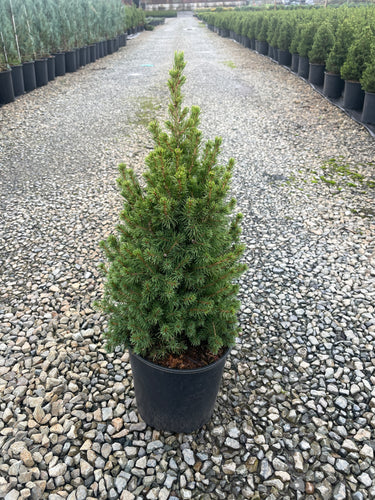
The leaves are needle-like and dense, offering a rich, bright green color throughout the year. The needles are soft to the touch, fine-textured, and densely packed on the tree, which gives Picea glauca 'Conica' its famous compact, symmetrical shape. The foliage provides year-round interest, especially in winter landscapes.

Flower Description

While the plant does not produce traditional flowers, it develops small, inconspicuous cones that appear in late spring or early summer. These cones are typically brownish and do not add significant ornamental value but are an integral part of its reproductive cycle.

Pruning & Maintenance

Little to no pruning is required to maintain the natural, dense, conical shape of Picea glauca 'Conica'. However, you can remove dead or damaged branches in late winter or early spring if necessary. Avoid heavy pruning, as it may disrupt the tree's natural form and slow its already minimal growth rate.

Water Needs

Water regularly during the first growing season to establish deep, healthy roots. Once established, Picea glauca 'Conica' prefers consistent moisture but is somewhat drought-tolerant. Water during dry spells, ensuring the soil remains moist but not waterlogged.

Light Needs
  • This dwarf spruce thrives in full sun but can tolerate partial shade. However, planting in full sun is recommended for the best growth and color development. In too much shade, the plant may lose its compact form and become sparse.
Harvesting

There is no need to harvest anything from Picea glauca 'Conica', as it is used primarily as an ornamental plant. The small cones that form do not have significant decorative or functional value.

Fertilizing

Fertilize in early spring with a slow-release, balanced fertilizer (10-10-10). Established trees generally require minimal feeding, but annual fertilization can help encourage healthy growth, especially in poor soil conditions.

Additional Care Tips
  • Mulching: Apply a 2-3 inch layer of mulch around the base of the tree to retain moisture and protect the roots from temperature fluctuations.
  • Pest and Disease Resistance: This plant is generally pest-resistant but can be susceptible to spider mites in hot, dry conditions. Regular watering and maintaining good air circulation around the plant can help prevent this issue.
  • Winter Care: Picea glauca 'Conica' is winter-hardy but can suffer from windburn in exposed locations. Plant in a sheltered area or use burlap wrapping to protect the foliage during severe winter conditions.
Pollination
  • Picea glauca 'Conica' is monoecious, meaning each plant has both male and female cones.
  • Pollination is wind-driven, and cones are not typically prominent on dwarf forms like 'Conica.'
  • Though capable of producing cones, fruiting is rare and not required for aesthetic or functional performance.
  • This variety is grown for its foliage and form, not reproductive structures.

Companion Plants

Evergreens & Shrubs:

  • Buxus (Boxwood) – Offers round form contrast and structure
  • Ilex crenata (Japanese Holly) – Glossy green leaves balance the fine spruce texture
  • Juniperus horizontalis ‘Blue Chip’ – Low-spreading blue foliage adds ground-level contrast

Grasses & Groundcovers:

  • Festuca glauca ‘Elijah Blue’ – Cool-toned, clumping grass echoes spruce tones
  • Heuchera (Coral Bells) – Colorful foliage (burgundy, chartreuse) adds vibrant underplanting
  • Sedum ‘Autumn Joy’ – Succulent texture with late-season blooms for pollinators

Flowering Perennials:

  • Lavandula angustifolia (English Lavender) – Fragrant, purple blooms contrast beautifully with dense green foliage
  • Salvia nemorosa ‘Caradonna’ – Adds vertical interest and pollinator value
  • Echinacea purpurea (Purple Coneflower) – Naturalistic texture softens the spruce’s form
Flowering and Seasonality
  • Seasonality: Evergreen; retains its foliage year-round
  • Flowering Season: Conifers like Picea glauca 'Conica' do not produce showy flowers, but instead form small cones.

While the plant does not produce traditional flowers, it develops small, inconspicuous cones that appear in late spring or early summer. These cones are typically brownish and do not add significant ornamental value but are an integral part of its reproductive cycle.

Pet Friendly

No

Growing Zone
  • Zone 3
  • Zone 4
  • Zone 5
  • Zone 6

Click to enlarge