Growing Information

Growing zone guide
Growing Zone Zone 4, Zone 5, Zone 6, Zone 7
Sunlight Medium to low light
Type of Soil Acidic to neutral
Mature Height 3 to 5 feet
Maintenance Level Low maintenance
Water Requirement Low watering (once every 2 weeks)

Learn more about this plant

Additional Information
Growth Rate

  • Speed: Slow to moderate growth rate, with the plant taking several years to reach its mature size.
  • Mature Height: Reaches 3-5 feet tall and 4-6 feet wide, forming a compact, rounded shrub ideal for foundation plantings, hedges, or as an accent plant.
Colorful Leaves No
Flowering No
Bloom Color N/A
Ornamental Berries Red berries
Disease resistant Yes
Cold Tolerant Yes
Heat Tolerant No
Drought Tolerant No
Deer Resistant No
Edible No
Wildlife Attraction
  • Pollinators: The flowers are not particularly attractive to pollinators, but the dense foliage provides shelter for small birds and other wildlife.
  • Wildlife Resistant: 'Morden' is resistant to deer, making it a good choice for gardens prone to deer browsing. However, the red fruits are attractive to birds, adding ecological value to your landscape.
Self-pollinating Cross-pollinating
Seasonality
  • Blooming Season: Taxus cuspidata 'Morden' produces inconspicuous yellow-green flowers in early spring (April to May). While the flowers are not showy, they are followed by small, red berry-like structures on female plants that add subtle interest in late summer.
Ideal For
  • Foundation Plantings – Dense, symmetrical growth makes it ideal near homes or walkways
  • Formal Hedges or Screens – Easily shaped and pruned into low hedges or privacy borders
  • Shade Gardens – Tolerates light shade better than most evergreens
  • Accent or Specimen Shrub – Works beautifully as a structural focal point in mixed beds
  • Topiary or Structured Forms – Excellent for shaping due to its dense, slow-growing nature

    Urban Landscapes – Tolerates pollution and adapts well to compacted soils
Leaf Description

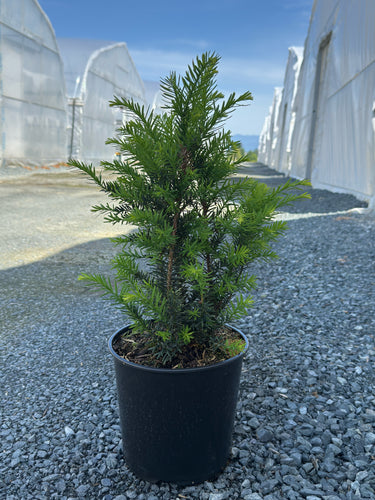
The foliage consists of soft, needle-like leaves that are deep green and densely packed. The evergreen foliage remains vibrant year-round, adding rich color and texture to the garden.

Flower Description

The flowers are small, yellow-green, and not significant in appearance, often going unnoticed. Male and female flowers grow on separate plants, with female plants producing the attractive red fruit.

Pruning & Maintenance

Prune in late winter or early spring to shape and maintain the desired size. Taxus 'Morden' responds well to pruning and can be trimmed into formal shapes or hedges. Avoid heavy pruning into old wood, as yews do not regenerate from bare branches.

Water Needs

Water regularly during the first growing season to establish deep roots. Once established, 'Morden' is drought-tolerant and requires only occasional watering, especially during dry periods. Ensure the soil is well-drained, as yews do not tolerate waterlogged conditions.

Light Needs

Thrives in full sun to partial shade. 'Morden' can tolerate deep shade, but foliage will be denser and more vibrant in areas with at least a few hours of direct sunlight.

Harvesting

While Taxus ‘Morden’ is not harvested for food or florals due to its toxicity, its evergreen foliage can be harvested for ornamental uses.

Fertilizing

Fertilize in early spring with a balanced, slow-release fertilizer to encourage healthy growth. Taxus generally requires minimal feeding once established, but a light application of fertilizer can boost growth, especially in poor soils.

Additional Care Tips
  • Pest & Disease: Taxus 'Morden' is relatively pest-free but can occasionally suffer from root rot if planted in poorly drained soil. Ensure proper drainage to prevent this issue. Additionally, yews are resistant to many common diseases, though monitoring for potential pests like scale or spider mites is recommended.
  • Mulching: Apply a 2-3 inch layer of mulch around the base of the plant to help retain moisture, suppress weeds, and protect the roots. Avoid piling mulch directly against the trunk to prevent rot.
  • Winter Care: Hardy in USDA Zones 4-7, 'Morden' requires no special winter care. In colder regions, mulch around the base of the plant to protect the roots from extreme cold, but the evergreen foliage will remain vibrant year-round.
  • Dividing: Not necessary, as yews are slow-growing and form a natural shape. However, they can be propagated through cuttings taken in late summer.
Pollination

Taxus cuspidata is dioecious, meaning male and female flowers grow on separate plants. The male flowers release pollen, which is wind-pollinated. Female plants produce small, red berry-like structures in late summer, which are attractive to birds.

Companion Plants

Evergreen Companions:

  • Buxus sempervirens (Boxwood) – Adds formality and structure
  • Ilex crenata (Japanese Holly) – Offers similar foliage and texture for variety
  • Juniperus ‘Blue Star’ – Contrasts well with Morden Yew’s dark green needles

Flowering Shrubs & Perennials:

  • Hydrangea arborescens ‘Annabelle’ – Showy white blooms brighten nearby shaded areas
  • Astilbe ‘Fanal’ – Feathery red plumes and shade tolerance complement Morden’s form
  • Helleborus orientalis (Lenten Rose) – Early spring color under partial shade

Ornamental Grasses & Groundcovers:

  • Carex morrowii ‘Ice Dance’ – Shade-tolerant with variegated foliage for contrast
  • Heuchera ‘Palace Purple’ – Deep burgundy leaves create rich color play
  • Pachysandra terminalis – Evergreen carpet under taller yews

Flowering and Seasonality
  • Blooming Season: Taxus cuspidata 'Morden' produces inconspicuous yellow-green flowers in early spring (April to May). While the flowers are not showy, they are followed by small, red berry-like structures on female plants that add subtle interest in late summer.

The flowers are small, yellow-green, and not significant in appearance, often going unnoticed. Male and female flowers grow on separate plants, with female plants producing the attractive red fruit.

Pet Friendly

No

Growing Zone
  • Zone 4
  • Zone 5
  • Zone 6
  • Zone 7

Click to enlarge