
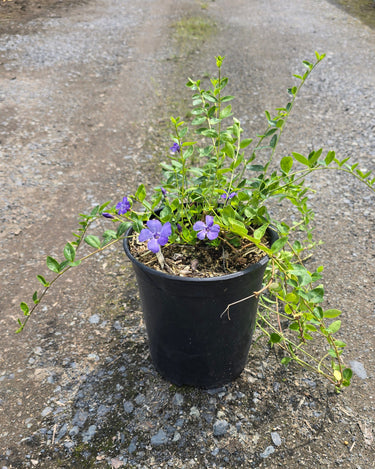

Bowles Cunningham Periwinkle
A superior large-flowered selection of periwinkle with abundant bright violet-blue blooms above glossy evergreen groundcover foliage — more floriferous than the species for shaded banks and borders. (Vinca minor 'Bowles Cunningham')
Vinca minor 'Bowles Cunningham' is a standout evergreen groundcover noted for its abundant lavender-blue flowers, robust spreading habit, and clean dark green foliage. Blooming more heavily than standard forms, it brings vibrant early spring color to shady and hard-to-plant areas such as under trees, on banks, or along woodland paths.
Its trailing stems root at the nodes, quickly forming a thick, weed-suppressing carpet. Easy to maintain and resistant to both deer and drought, this cultivar is a reliable solution for erosion control, shaded mass plantings, and low-maintenance design in both residential and commercial landscapes.
Your payment information is processed securely. We do not store credit card details nor have access to your credit card information.
Growing Information
Growing zone guideLearn more about this plant
Additional Information
| Growth Rate | |
|---|---|
| Colorful Leaves | No |
| Flowering | |
| Bloom Color | Blue |
| Ornamental Berries | N/A |
| Disease resistant | |
| Cold Tolerant | |
| Heat Tolerant | |
| Drought Tolerant | |
| Deer Resistant | |
| Edible | |
| Wildlife Attraction | |
| Self-pollinating | Self-pollinating |
| Seasonality | |
| Ideal For | |
| Leaf Description | |
| Flower Description | |
| Pruning & Maintenance | |
| Water Needs | |
| Light Needs | |
| Harvesting | |
| Fertilizing | |
| Additional Care Tips | N/A |
| Pollination | |
| Companion Plants |
Flowering and Seasonality
Pet Friendly
No
Growing Zone
- Zone 4
- Zone 5
- Zone 6
- Zone 7
- Zone 8
- Zone 9
Click to enlarge
Growing Zone

You may also like


